

 por
por What Is It, How to Perform It, and More
Auscultation refers to the technique performed by a variety of healthcare professionals, during a physical examination in order to listen to the internal sounds of the body, such as the heart sounds, lung sounds, and bowel sounds.
Auscultation is performed by placing a stethoscope, or a medical instrument used to listen to the internal sounds of the body, flat on the body at different locations corresponding to different organs of the body.

A stethoscope has two sides, a bell and a diaphragm. The diaphragm of the stethoscope is the larger flat side and is generally used to listen for normal high-pitched sounds that may occur in the heart, lungs and abdomen, as well as abnormal sounds that may occur.

On the other hand, the bell of the stethoscope is the cone-shaped side of the stethoscope and is generally used to listen for low-pitched sounds, such as heart murmurs, which are extra heart sounds that can occur with heart failure, as well as the sound of turbulent flowing blood, also known as a murmur.
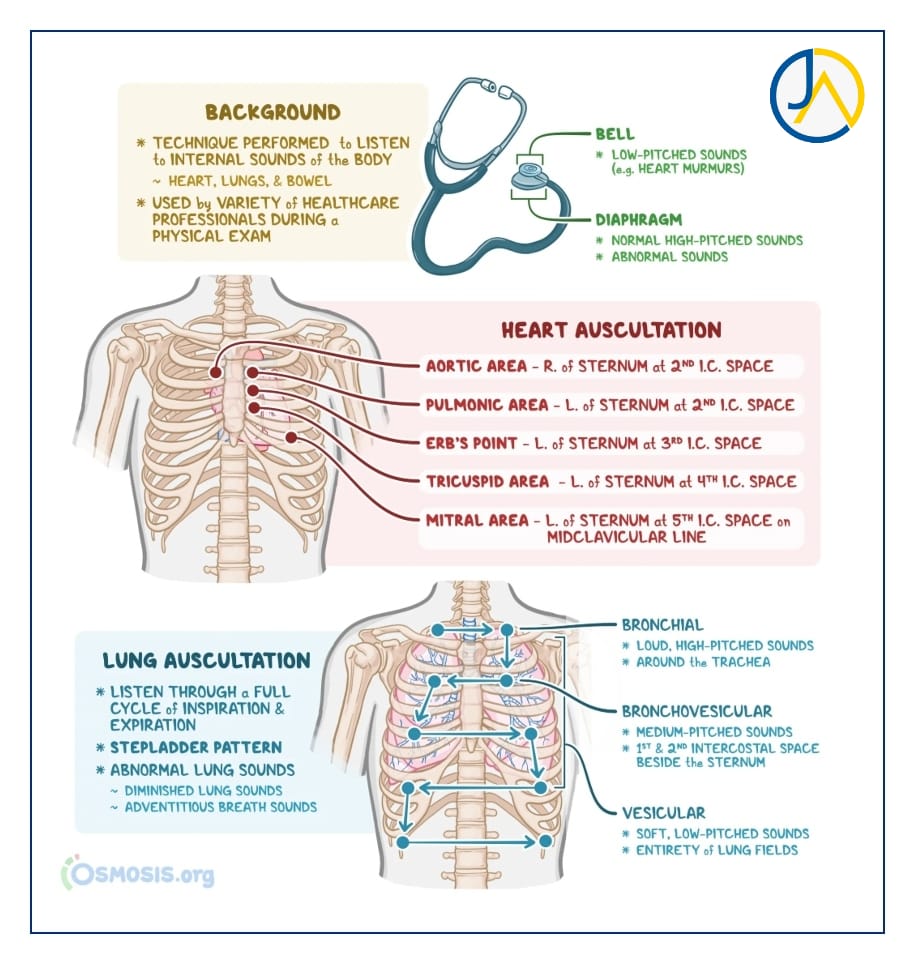
The 5 auscultation points of the heart are centered around the heart valves and include the aortic, pulmonary, tricuspid and mitral valves, as well as an area called Erb’s point. The auscultation points of the lungs match the type of breath sounds heard and include the area around the trachea, the area between the 1st and 2nd intercostal space on the anterior and posterior sides of the chest, and bilaterally throughout the lung fields. The auscultating physician will listen for a complete cycle of inspiration and expiration at each site using a staircase pattern, listening for both normal and abnormal breath sounds.
References

Auscultation. In Medlineplus medical encyclopedia. Retrieved March 05, 2023

Auscultation. On Mount Sinai. Retrieved on March 05, 2023